May 16 to July 12, 2026
Iaohontso’ktá:tie / To Move Across the Land: Making Otherwise: Process, Transmission, and Refusal
Curators: Armando Perla & Michael Patten
La Biennale d’art contemporain autochtone (BACA), 8th edition
Quai 5160 – Maison de la culture de Verdun
5160 Blvd. LaSalle, Verdun, QC, H4H 1N8
Didine Ángel, Feeonaa Clifton, Federico Cuatlacuatl, Elvira Espejo, Didine Ángel, Feeonaa Clifton, Federico Cuatlacuatl, Elvira Espejo, Guillermo Jester & Esperanza Pérez, Aroha Millar, Sam Ojeda, Israel Randell, Juan Carlos Recinos, Samuel Thomas, Renati Waaka.
This exhibition traces how knowledge moves across different conditions: conflict, continuity, and transformation, situating these movements within the broader question of borders as colonial limits imposed on language, land, and bodies.
Some works emerge from moments of pressure. Feeonaa Clifton activates roadwork signage to foreground te reo Māori and gagana Sāmoa in public space, pushing against linguistic boundaries that regulate visibility. Suzanne Tamaki reanimates the statue of John Hamilton to expose the violence embedded in settler commemoration, unsettling the authority of colonial monuments. In Didine Ángel’s performance, the body carries the weight of forced migration and racialized erasure, articulating movement as both necessity and survival across imposed borders. Making operates as intervention, a way to speak within conditions that attempt to silence or contain.
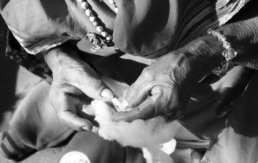
Other works assert continuity. Elvira Espejo’s weaving hands foreground knowledge transmitted through gesture and repetition, maintaining systems that exceed colonial divisions between past and present. Israel Randell’s tapa cloth installation, produced collectively with Māori women in Aotearoa, emphasizes intergenerational labour and shared authorship that move across imposed separations of individual and collective practice. Simon Thomas’s and Sam Ojeda’s beadwork, alongside Esperanza López’s pleated garments, sustain techniques grounded in land, lineage, and adaptation, carrying this knowledge into contemporary practices that move across temporal and territorial boundaries.
A third movement extends these practices forward. In the photographic collaboration of Aroha Millar and Renati Waaka, adornment becomes a site of transformation where ancestral knowledge crosses into new forms of embodiment. Federico Cuatlacuatl’s Indigenous astronaut similarly projects presence into speculative space, shifting the temporal frame toward futures that exceed colonial limits.
These works illustrate how making becomes a way of holding knowledge, moving across boundaries, and shaping what comes next.
The Biennale d’art contemporain autochtone (BACA) would like to thank its partners the Canada Council for the Arts, the Government of Quebec, the Conseil des arts et des lettres du Québec, the Secrétariat aux relations avec les Premières Nations et les Inuit, the Conseil des arts de Montréal, Tourisme Montréal, the Collection Desjardins and Creative New Zealand.